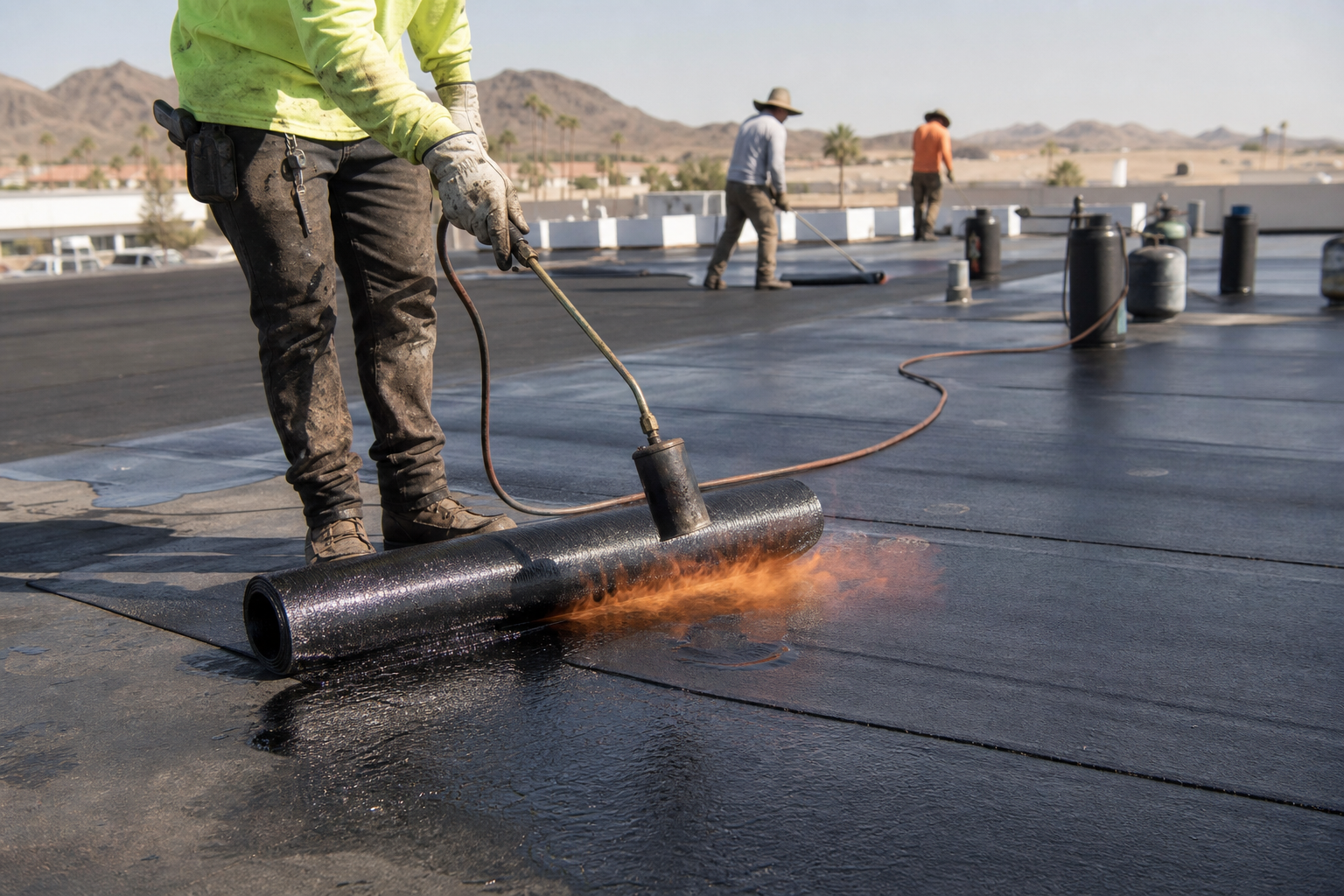
Built-Up Roofing (BUR) in Mesa, AZ — Multi-Ply Commercial Roofing Systems
Multi-ply bituminous systems for flat commercial roofs demanding maximum redundancy. Favored for retail, hospitality, and municipal buildings in the Mesa market.
Mesa Commercial Roofing Co. Built-up roofing — BUR — is one of the oldest commercial roofing systems in the United States, and it's still being specified for good reason. Multiple alternating layers of bitumen and reinforcing felt create a roofing assembly with inherent redundancy: if one layer is compromised, the layers below continue to perform. In an industry where 'single point of failure' is a constant risk, built-up roofing's multi-ply nature is a genuine advantage.
Modern BUR and modified bitumen systems are significantly improved over the coal-tar systems of the mid-20th century. SBS-modified and APP-modified bitumen membranes add elastomeric or atactic polypropylene compounds to the bitumen matrix, creating flexibility and UV resistance that traditional built-up systems lacked.
Understanding Built-Up Roofing vs. Modified Bitumen
These terms are related but distinct:
Traditional BUR. Three to five alternating plies of roofing felt (fiberglass or organic) mopped in hot bitumen, topped with a surfacing layer — gravel, cap sheet, or aluminum-coated cap. The multiple plies create the redundancy that makes BUR durable. Traditional BUR is still installed on commercial buildings where the building type or owner preference calls for it, and is one of the best-documented roofing systems in existence.
Modified Bitumen. Two-ply systems using polymer-modified bitumen sheets — either SBS (styrene-butadiene-styrene) modified for flexibility, or APP (atactic polypropylene) modified for heat resistance. Applied by torch (APP), hot-mopped (SBS), cold-applied adhesive, or self-adhered. Modified bitumen is faster to install than traditional BUR, compatible with most deck types, and provides the redundancy of multiple plies without the complexity of traditional BUR application.
Combination systems. Many commercial installations use a BUR base with a modified bitumen cap sheet — getting the redundancy of the multi-ply base and the weather-resistance of the modified cap.
Where BUR and Modified Bitumen Excel
Heavy-use roofs. Gravel-surfaced BUR and granulated modified bitumen cap sheets provide surface protection from foot traffic, HVAC maintenance activity, and debris impact that single-ply membranes can't match without additional protection boards.
Roofs with extreme thermal exposure. High-temperature APP-modified systems handle the sustained heat loading of Arizona's peak summer conditions — surface temperatures above 170°F — without the softening and flow issues that can affect some single-ply membranes.
Buildings with long ownership cycles. The multi-ply redundancy means a BUR or modified bitumen system can be maintained and repaired for decades. Many commercial buildings in Mesa's mature industrial and retail districts have BUR systems installed in the 1970s and 1980s that have been maintained and re-surfaced to remain functional.
Low-slope roofs with complex drainage. Gravel-ballasted BUR on a properly designed substrate handles the transition from heavy rain to dry periods without the ponding water concerns that affect single-ply adhesive seams.
Installation Methods
Hot-mopped. Traditional kettle-heated bitumen applied between plies. Requires experienced crews and careful temperature control. Produces very reliable ply adhesion when done correctly.
Torch-applied. APP-modified bitumen is torch-welded to the substrate. Produces high bond strength and eliminates the equipment requirements of hot-mopped work. Requires fire safety protocols — we coordinate with building management on fire watch requirements for torch-applied work on occupied buildings.
Cold-applied. Solvent or water-based adhesives applied between plies. Slower to cure, requires correct temperature conditions, but eliminates open-flame equipment. Preferred in fire-sensitive environments.
Self-adhered. Factory-applied adhesive on the back of the sheet is activated by removing a release liner. Cleanest installation method, no flame or hot materials. Used increasingly on projects where torch and kettle work are restricted.
Maintaining and Restoring Existing BUR Systems
Existing BUR and modified bitumen roofs in good substrate condition can be restored rather than replaced:
Flood coat and gravel. Worn gravel-surfaced BUR can be renewed with a flood coat of bitumen and fresh gravel application over the existing system. Extends life significantly at low cost.
Elastomeric coating over smooth-surfaced modified bitumen. Cap sheets that have lost their granular surfacing can be cleaned and coated with reflective elastomeric systems. Restores weatherability, adds solar reflectance, and extends system life.
Modified bitumen recover. A fresh modified bitumen cap sheet over existing BUR. Adds a new weather surface and extends life 15–20 years without tear-off cost.
Commercial Applications in the Mesa Market
Retail and strip centers. Many of Mesa's commercial strips built in the 1980s–1990s carry modified bitumen systems. We maintain and re-surface these roofs for property managers managing large portfolios.
Hospitality. Hotels and motels in the East Valley frequently specify BUR or modified bitumen for their flat roof sections — the system's tolerance for foot traffic from rooftop HVAC maintenance and the reliability of the multi-ply assembly suits the 24/7 operation of hospitality properties.
Municipal and institutional. Schools, city facilities, and library buildings across Mesa have been built with BUR systems for decades. We work with facilities management teams on these public buildings, including navigating the public procurement process.
Common Questions
Is built-up roofing still a good choice for commercial buildings?
What's the difference between SBS and APP modified bitumen?
Can BUR or modified bitumen be overlaid with TPO?
How do I know if my building's old BUR needs replacement vs. restoration?
Related Solutions
TPO Roofing
Thermoplastic polyolefin roofing systems built for Arizona's brutal sun. We install, repair, and maintain TPO membranes across Mesa's commercial sector.
Roof Coating & Restoration
Silicone and acrylic roof coatings restore aging membranes, stop leaks, and slash cooling costs. Often half the price of a full replacement.
Commercial Roof Repair
Leaks, membrane splits, flashing failures, ponding water — we diagnose and fix commercial roofing problems the same week you call.
Serving Mesa, Phoenix, Scottsdale, Chandler, Gilbert, Tempe, Glendale, Peoria, Queen Creek, and Apache Junction. Mesa Commercial Roofing Co. handles commercial roofing across the entire East Valley.