Commercial Restaurant Roofing in Mesa, AZ — Built for HVAC & Kitchen Loads
High-grease exhaust, rooftop HVAC units, frequent penetrations — restaurant roofs are brutalized. We spec and install systems that hold up to the kitchen.
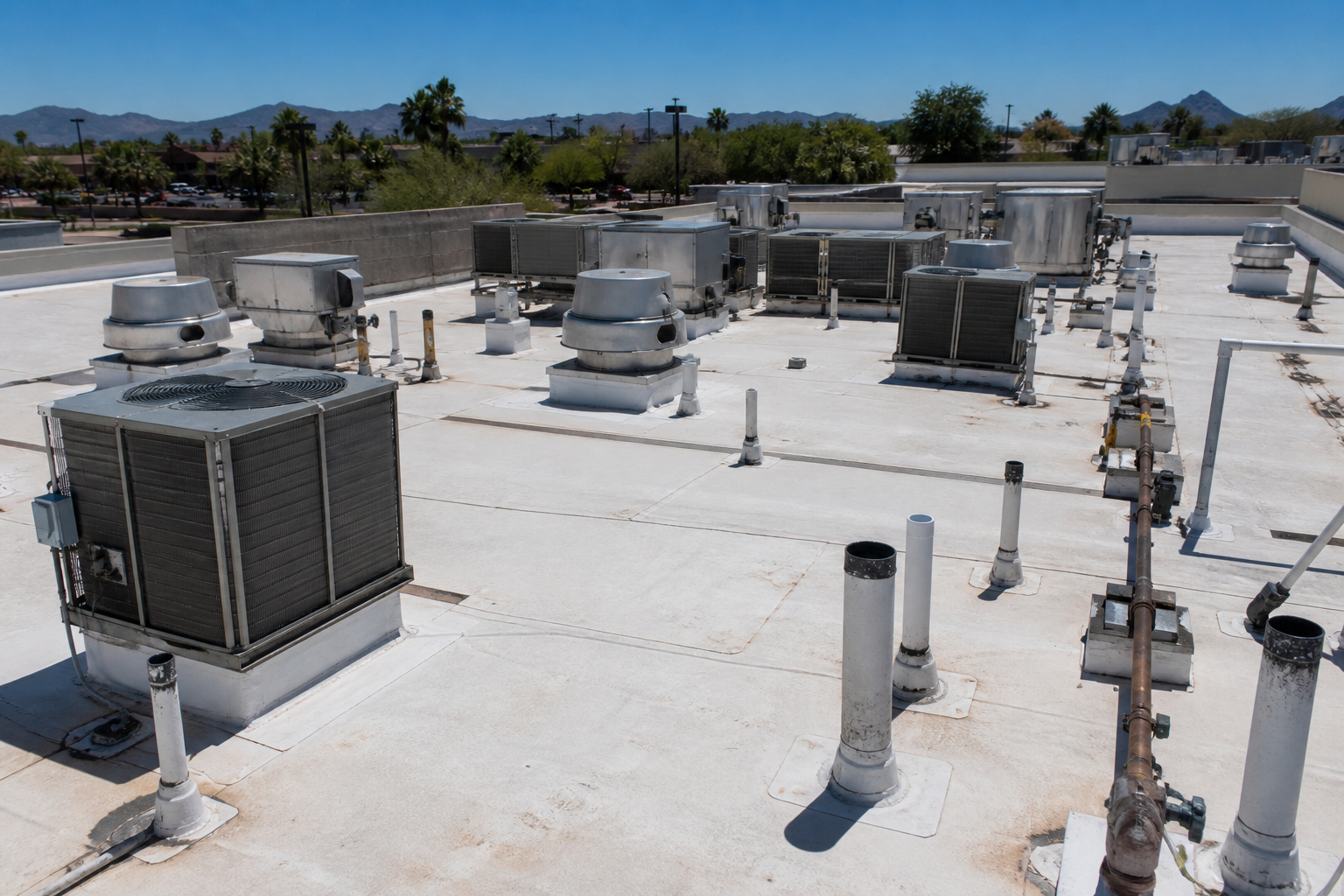
Mesa Commercial Roofing Co. Restaurant roofs are the hardest-working commercial roofs in existence. They're loaded with rooftop HVAC condensing units, make-up air handlers, grease exhaust fans, and condensate drain lines — more penetrations per square foot than almost any other building type. The grease exhaust alone degrades standard roofing materials at a rate that would shock most property managers who've only ever owned office buildings.
We've roofed hundreds of restaurants across the East Valley — everything from standalone QSR pads and fast-casual strip bays to full-service dining and ghost kitchen facilities. We understand the penetration density, the HVAC coordination requirements, and the operational realities that make restaurant roofing different from every other commercial roof job.
What Makes Restaurant Roofing Unique
Grease exhaust degradation. Type I kitchen exhaust hoods vent grease-laden air through fans on the roof. That grease settles on the surrounding membrane and — if the exhaust fan isn't properly maintained — can accumulate in concentrations that break down standard roofing materials within years. TPO, EPDM, and modified bitumen all degrade on contact with concentrated petroleum-based grease. We use chemical-resistant flashing materials at exhaust curb penetrations and specify curb accessories that direct condensed grease away from the membrane.
Penetration density. A 3,000 sq ft fast-food restaurant might have 8–12 major rooftop equipment curbs, 4–6 plumbing vents, multiple conduit penetrations, and two or three exhaust fans. Each one is a potential leak point. Each one needs to be flashed correctly. We pre-build as many curb flashings as possible in controlled conditions before they go on the roof, reducing field fabrication risk.
Constant equipment changes. Restaurant equipment gets replaced, upgraded, and reconfigured constantly. Every time a curb gets moved or a new piece of equipment goes up, there's a penetration in the roof. We work with kitchen equipment contractors and restaurant owners to coordinate rooftop changes so membrane penetrations are closed correctly every time.
Thermal load from kitchen exhausts. The area surrounding active Type I exhaust fans can reach significantly higher temperatures than the rest of the roof surface. Membrane selection and thickness in these zones matters.
Recommended Roofing Systems for Restaurant Buildings
PVC membrane for high-grease applications. PVC (polyvinyl chloride) has the best inherent resistance to animal and vegetable fats of any commercial membrane type. For restaurants with significant grease exhaust activity, PVC is worth the premium over TPO. Properly installed and maintained, PVC over a restaurant will outlast TPO by years in grease-exposed zones.
TPO with chemical-resistant flashing accessories. If the restaurant's grease management is tight and the exhaust systems are well-maintained, TPO with properly specified flashing at the exhaust curbs performs well and costs less than PVC. We assess the grease load and exhaust maintenance history before recommending one over the other.
Modified bitumen for older buildings. Many existing restaurant buildings in Mesa's older commercial corridors have modified bitumen roofs. We repair, maintain, and recover these with TPO or PVC overlays when they reach end of life.
Working Around Restaurant Operations
Restaurants can't close for roof work in most cases. We schedule restaurant roofing around operating hours, often working early morning or overnight to complete the most disruptive phases. We coordinate with the kitchen to avoid rooftop access during peak rush, and we communicate with management at every phase.
For occupied restaurants, we use phased installation sequences that keep the building weathered-in at all times — no section of exposed deck at end of day.
Maintenance Programs for Restaurant Roofs
Restaurant roofs need more frequent inspection than most commercial buildings because the grease, the HVAC load cycling, and the constant equipment activity create more failure opportunities. We recommend twice-yearly inspection for active restaurants and after any equipment replacement or addition.
Our restaurant maintenance program includes: membrane condition at all penetrations, grease accumulation assessment and cleaning, HVAC curb inspection, drain clearing, and a written report that documents the rooftop equipment inventory — useful when planning HVAC replacements.
Case: Fast-Casual Restaurant Strip, Gilbert AZ
A fast-casual chain operating in a 10-unit Gilbert strip center brought us in after their third different roofing contractor failed to stop a persistent leak at the make-up air handler on Unit 4. Our inspection found the original flashing had been field-fabricated with EPDM tape over a TPO membrane — incompatible materials. Every "repair" the prior contractors made added a layer over the incompatible junction rather than removing and correctly re-flashing it.
We removed all prior repair material, properly transitioned the curb flashing to TPO-compatible components, and heat-welded the entire curb perimeter to the field membrane. No callbacks in 18 months since.
Common Questions
How often should a restaurant roof be inspected?
My restaurant has grease pooling on the roof. Is that a roofing problem?
Can I replace rooftop HVAC without a roofer present?
What's the typical cost to roof a 3,000 sq ft restaurant building?
Related Solutions
TPO Roofing
Thermoplastic polyolefin roofing systems built for Arizona's brutal sun. We install, repair, and maintain TPO membranes across Mesa's commercial sector.
Commercial Roof Repair
Leaks, membrane splits, flashing failures, ponding water — we diagnose and fix commercial roofing problems the same week you call.
Roof Inspection & Maintenance
Twice-yearly inspections, documented reports, small repairs caught before they become big ones. Our maintenance programs keep warranties intact and roofs performing.
Serving Mesa, Phoenix, Scottsdale, Chandler, Gilbert, Tempe, Glendale, Peoria, Queen Creek, and Apache Junction. Mesa Commercial Roofing Co. handles commercial roofing across the entire East Valley.