Commercial Roof Repair in Mesa, AZ — Leaks Fixed the Same Week You Call
Leaks, membrane splits, flashing failures, ponding water — we diagnose and fix commercial roofing problems the same week you call.
Mesa Commercial Roofing Co. Commercial roof leaks don't wait for a convenient time. They show up during monsoon season, during your busiest quarter, when the building is fully occupied and every drop of water is a liability. The difference between a contractor who can diagnose and fix a commercial leak the same week you call and one who shows up three weeks later with the wrong materials is the difference between a $2,000 repair and a $40,000 interior remediation.
We run a dedicated repair division, not a crew of installers who handle repairs when they have time between new construction. Our repair technicians carry the common membrane materials, flashing components, and seam tapes for every major system — TPO, EPDM, modified bitumen, built-up, and metal — so they can make a permanent repair on the first visit rather than a temporary patch and a return trip.
The Most Common Commercial Roof Failure Points
Over 20 years of commercial repair work in the East Valley, these are the failure points we diagnose most frequently:
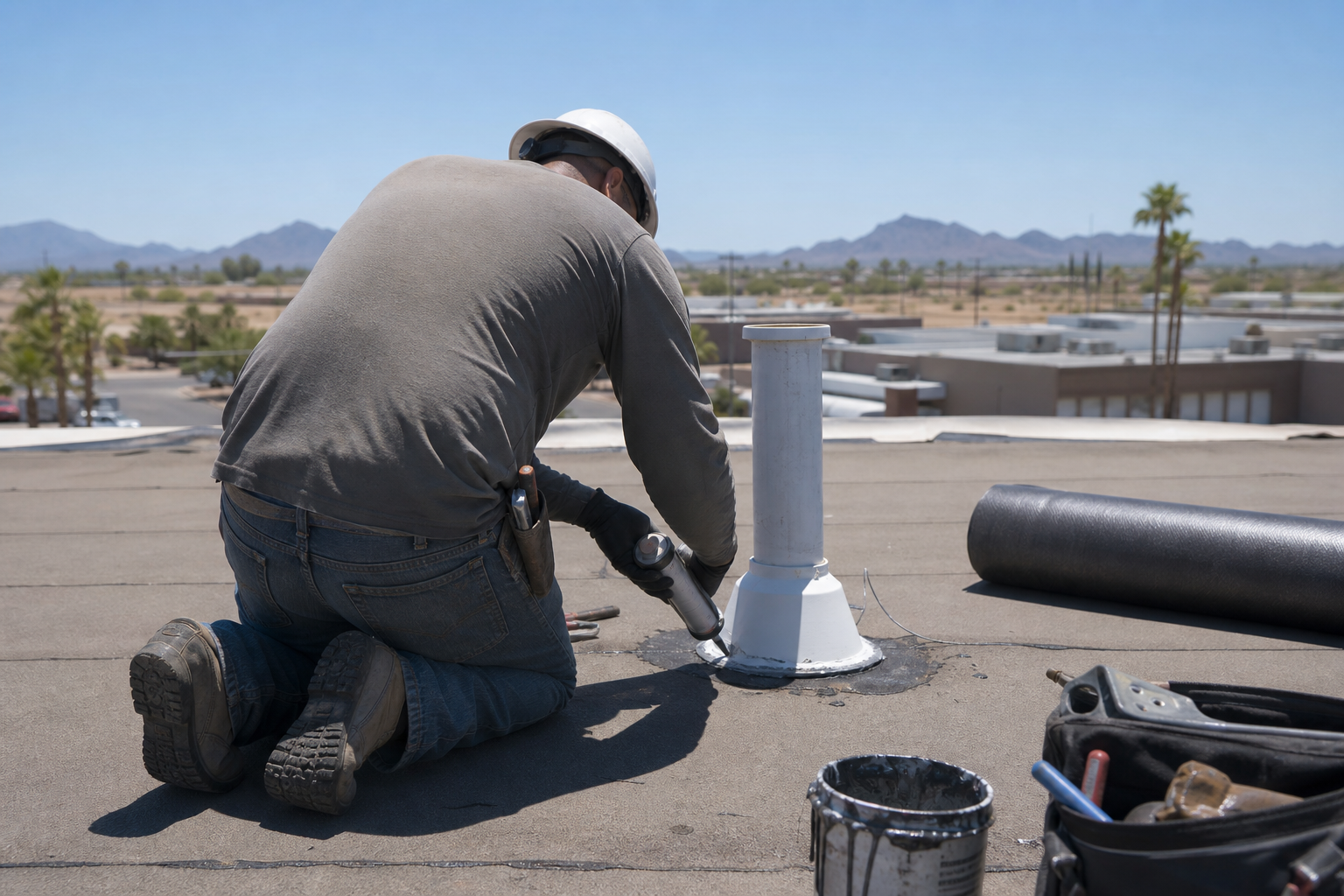
Penetration flashing failures. Every HVAC curb, pipe boot, conduit penetration, and exhaust fan is a point where the continuous membrane is interrupted. Flashing materials degrade faster than field membrane — especially in Arizona's UV environment. Caulked pipe boots and jacketed penetrations begin to fail at 5–10 years even on relatively new roofs. We re-flash penetrations with permanent materials — welded TPO, bonded EPDM, or prefabricated metal — rather than re-caulking.
Seam delamination. Heat-welded TPO seams fail when they were under-welded at installation. Adhesive-bonded EPDM seams fail when the adhesive is old or the bonding was contaminated. Modified bitumen laps fail when the bitumen wasn't fully heated during installation. Seam failures are typically linear — once we find one failing section, we probe the entire seam run to find adjacent weakness.
Drain and scupper blockages with resulting membrane damage. Standing water is the primary accelerant of commercial roof deterioration. When drains clog and water ponds, it stresses seams, drives moisture under membrane edges, and in freeze-thaw climates, physically lifts membrane. In Arizona, ponding water during monsoon season drives a significant portion of our repair calls every September.
Parapet wall cap and counterflashing failures. Metal coping caps expand and contract more than the membrane below them. Over time, the coping joint sealants fail, water drives in behind the counterflashing, and the top of the parapet wall begins to delaminate. We see this on virtually every building over 15 years old that hasn't had its parapet flashing inspected.
Membrane punctures and cuts. Rooftop HVAC maintenance, antenna and satellite installation, and general mechanical contractor foot traffic causes punctures and cuts in commercial membranes. Many are never reported by the contractors who cause them. Our inspection process includes probing the membrane field for concealed damage.
Our Repair Process
We don't just fix the symptom. When we respond to a commercial leak call:
1. Interior trace first. We ask about water entry locations inside the building and map them relative to the roof above. Water rarely enters directly above where it appears inside — it travels along deck slopes, structural members, and insulation layers.
2. Roof inspection with moisture tools. We use electronic leak detection and infrared imaging where appropriate to locate water in the insulation layer below the membrane. This tells us whether we're dealing with a fresh entry point or a long-standing wet insulation condition.
3. Document before repair. Photos of every defect, every repair location, and the condition before and after. You get a repair report with the invoice.
4. Permanent repairs, not patches. We use the appropriate repair method for each failure mode — seam tape and silicone aren't the right repair for a failed EPDM seam on a 20-year-old membrane if the surrounding area is brittle. We assess what a repair can realistically hold and give you an honest assessment of when that section needs replacement.
Emergency Response
We maintain response capacity for active-leak emergencies during business hours. For occupied buildings with active water entry, we carry emergency waterproofing materials that can stabilize a situation while a permanent repair is planned and scheduled.
Repair vs. Restoration vs. Replacement
Every repair call is an opportunity to get an honest assessment of your roof's overall condition. If we're making our third repair to the same section in five years, we'll tell you. If the overall system is approaching end of life, we'll flag it with documentation so you can plan a capital replacement — rather than getting surprised by it.
We're not in the business of selling you a repair if a coating restoration makes more economic sense, and we're not going to push a restoration if the substrate condition requires replacement. Our repair team's job is to tell you the truth and fix it correctly.
Common Questions
How quickly can you respond to an active commercial roof leak?
How do I know if my roof leak is coming from the roof or from a wall or window?
Is it worth repairing an old commercial roof or should I just replace it?
Do commercial roof repairs require permits?
Related Solutions
TPO Roofing
Thermoplastic polyolefin roofing systems built for Arizona's brutal sun. We install, repair, and maintain TPO membranes across Mesa's commercial sector.
Roof Coating & Restoration
Silicone and acrylic roof coatings restore aging membranes, stop leaks, and slash cooling costs. Often half the price of a full replacement.
Roof Inspection & Maintenance
Twice-yearly inspections, documented reports, small repairs caught before they become big ones. Our maintenance programs keep warranties intact and roofs performing.
Serving Mesa, Phoenix, Scottsdale, Chandler, Gilbert, Tempe, Glendale, Peoria, Queen Creek, and Apache Junction. Mesa Commercial Roofing Co. handles commercial roofing across the entire East Valley.