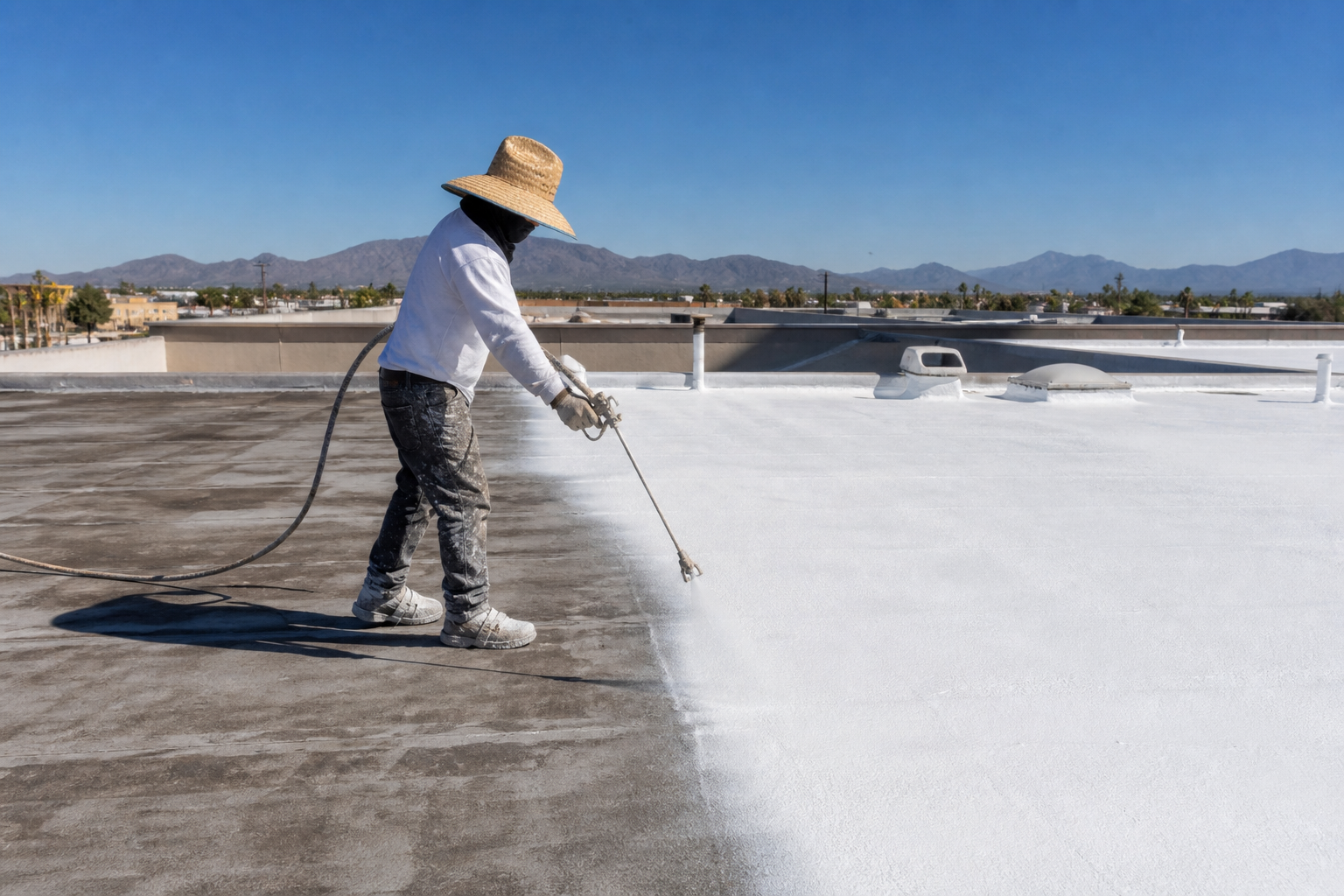
Commercial Roof Coating in Mesa, AZ — Add 10–20 Years Without Tear-Off
Silicone and acrylic roof coatings restore aging membranes, stop leaks, and slash cooling costs. Often half the price of a full replacement.
Mesa Commercial Roofing Co. A roof coating is not a band-aid. Done correctly, a commercial roof coating system is a legitimate restoration method that adds 10–15 years to an aging roof, reduces cooling energy costs by 20–30%, and costs 40–60% less than a full replacement. Done wrong — applied over wet insulation, over deteriorated substrate, without proper preparation — it's an expensive mistake that leaves you right back where you started.
We approach coating projects the same way we approach full replacements: with a thorough moisture scan, a substrate evaluation, and a documented scope. If the insulation is wet, the deck is deteriorated, or the membrane has lost its integrity to the point where coating won't hold, we'll tell you that before you spend money on a system that won't perform.
Types of Commercial Roof Coatings
Silicone roof coatings. The best performer for Arizona's conditions. Silicone maintains its flexibility and adhesion in extreme heat, resists ponding water indefinitely without degrading (unlike acrylics), and provides the highest solar reflectance values of any coating type. If your roof has areas of standing water, silicone is the only coating that won't deteriorate in those zones. The trade-off: silicone is slippery when wet, which affects foot traffic safety, and it accepts topcoat less readily over time (though it can be re-coated with silicone).
Acrylic roof coatings. Water-based, easy to apply, and excellent at solar reflectance when new. Acrylics are cost-effective for roofs with good drainage and no significant ponding water. They erode in ponding water zones — a foot of standing water for 48 hours will wash out acrylic coating. In Arizona, where monsoon events dump significant water quickly, drainage capacity assessment is critical before specifying acrylic.
Polyurethane coatings. Two types: aromatic (used as a base coat for UV resistance) and aliphatic (topcoat for color stability). Polyurethane coatings provide excellent impact and abrasion resistance — important on high-traffic roofs with maintenance crews moving heavy equipment. Often specified as a two-coat system over existing spray polyurethane foam (SPF) roofs.
Spray polyurethane foam (SPF) with topcoat. Technically a restoration system, not just a coating. SPF is sprayed onto the existing roof to fill low spots, improve slope for drainage, add significant R-value, and create a monolithic surface without seams. Coated with a protective topcoat (typically silicone or polyurethane), SPF systems perform extremely well in the desert climate and can turn a drainage problem into a non-issue.
The Preparation Requirement
Roof coating fails most often not because the product is wrong but because of inadequate surface preparation. The sequence matters:
1. Moisture scan — infrared or nuclear moisture scan to identify wet insulation areas. Coating over wet insulation traps the moisture, accelerates deck deterioration, and produces coating adhesion failures. 2. Cleaning — commercial roof surfaces are loaded with chalking membrane material, dirt, grease residue near HVAC exhausts, and biological growth. We pressure wash and clean with appropriate surfactants before any coating application. 3. Repairs — every failed seam, every open penetration, every damaged area gets repaired before coating goes on. The coating is not a repair mechanism; it's a protective layer applied over a sound substrate. 4. Primer where required — many coating systems require primer over EPDM, certain TPO formulations, or aged surfaces. Skipping primer to save money on a coating project is among the most common reasons coating jobs fail.
Cost Comparison: Coating vs. Replacement
For a 50,000 sq ft commercial roof in Mesa:
- Full TPO replacement (tear-off, new insulation, new membrane): $350,000–$600,000
- Roof coating restoration (silicone system over existing membrane): $100,000–$180,000
- Expected life extension from coating: 10–15 years
If the building is being held for 8–10 years and then sold or redeveloped, coating often makes more economic sense than replacement. If the building is a long-term hold with a deteriorated substrate, replacement is the right call. We help ownership groups model both scenarios.
Warranty Coverage on Coated Roofs
Several major coating manufacturers offer 10–15 year material and workmanship coverage on properly specified and installed coating systems. Qualifying for manufacturer coverage requires documented preparation, material application at specified mil thickness (verified with wet mil and dry mil gauges), and proper primer use. We maintain manufacturer certifications for the systems we install.
Maintenance After Coating
The annual maintenance for a coated roof is simple: inspect seams and penetrations, patch any mechanical damage, clear drains. The coating itself is self-healing to a point in silicone systems — minor surface cracks in silicone flow back closed in hot weather. A well-maintained coated roof can be re-coated at the end of its warranty period and continue performing for another cycle.
Common Questions
Can any commercial roof be coated?
How thick does a silicone coating need to be?
How long does a roof coating application take?
What maintenance does a coated roof require?
Related Solutions
TPO Roofing
Thermoplastic polyolefin roofing systems built for Arizona's brutal sun. We install, repair, and maintain TPO membranes across Mesa's commercial sector.
EPDM Roofing
Durable synthetic rubber membranes that handle thermal cycling and UV exposure. Ideal for office buildings, schools, and multi-tenant commercial properties.
Commercial Roof Repair
Leaks, membrane splits, flashing failures, ponding water — we diagnose and fix commercial roofing problems the same week you call.
Serving Mesa, Phoenix, Scottsdale, Chandler, Gilbert, Tempe, Glendale, Peoria, Queen Creek, and Apache Junction. Mesa Commercial Roofing Co. handles commercial roofing across the entire East Valley.